The English language has developed over the course of more than 1,400 years. The earliest forms of English, a set of Anglo-Frisian dialects brought to Great Britain by Anglo-Saxon invaders in the fifth century, are called Old English.
Beowulf is the most famous work in Old English, and has achieved national epic status in England, despite being set in Scandinavia. However, following the Norman conquest of England in 1066, the written form of the Anglo-Saxon language became less common. Under the influence of the new aristocracy, French became the standard language of courts, parliament, and polite society.
Beowulf is an Old English epic poem in the tradition of Germanic heroic legend consisting of 3,182 alliterative lines. It is one of the most important and most often translated works of Old English literature. The date of composition is a matter of contention among scholars; the only certain dating is for the manuscript, which was produced between 975 and 1025.
Click to read Beowulf Translation by Lesslie Hall
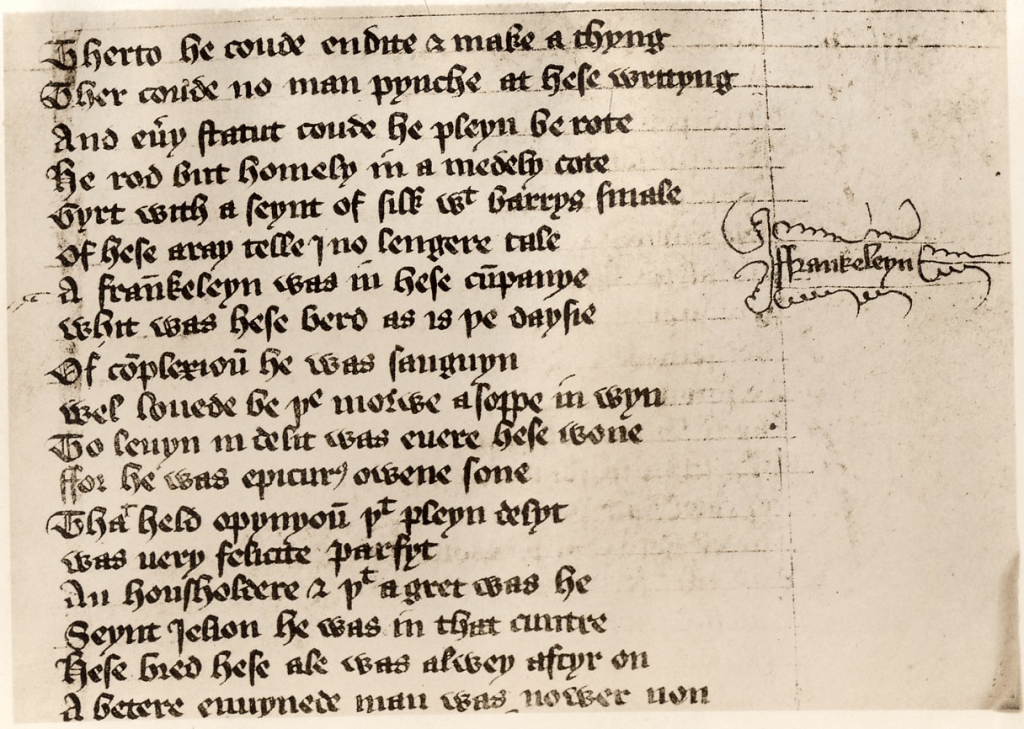
The English spoken after the Normans came is known as Middle English. This form of English lasted until the 1470s, when the Chancery Standard (late Middle English), a London-based form of English, became widespread. Geoffrey Chaucer (1343 – 1400), author of The Canterbury Tales, was a significant figure in the development of the legitimacy of vernacular Middle English at a time when the dominant literary languages in England were still French and Latin.
Click to read Canterbury Tales
The invention of the printing press by Johannes Gutenberg in 1439 also helped to standardise the language, as did the King James Bible (1611), and the Great Vowel Shift.Poet and playwright William Shakespeare (1564 – 1616) is widely regarded as the greatest writer in the English language and one of the world’s greatest dramatists. His plays have been translated into every major living language and are performed more often than those of any other playwright. In the nineteenth century Sir Walter Scott’s historical romances inspired a generation of painters, composers, and writers throughout Europe.
Click to read King James Bible

Old English literature, or Anglo-Saxon literature, encompasses the surviving literature written in Old English in Anglo-Saxon England, in the period after the settlement of the Saxons and other Germanic tribes in England (Jutes and the Angles) c. 450, after the withdrawal of the Romans, and “ending soon after the Norman Conquest” in 1066. These works include genres such as epic poetry, hagiography, sermons, Bible translations, legal works, chronicles and riddles. In all there are about 400 surviving manuscripts from the period.
According to Bede, the 7th century work Cædmon’s Hymn is considered as the oldest surviving poem in English. Poetry written in the mid-12th century represents some of the latest post-Norman examples of Old English. For example, The Soul’s Address to the Body (c. 1150–1175) found in Worcester Cathedral Library MS F. 174 contains only one word of possible Latinate origin, while also maintaining a corrupt alliterative meter and Old English grammar and syntax, albeit in a degenerative state (hence, early scholars of Old English termed this late form as “Semi-Saxon”).
After the Norman conquest of England in 1066, the written form of the Anglo-Saxon language became less common. Under the influence of the new aristocracy, French became the standard language of courts, parliament, and polite society. As the invaders integrated, their language and literature mingled with that of the natives, and the Norman dialects of the ruling classes became Anglo-Norman. From then until the 12th century, Anglo-Saxon underwent a gradual transition into Middle English.
Renaissance style and ideas were slow to penetrate England and the Elizabethan era (1558–1603) is usually regarded as the height of the English Renaissance. However, many scholars see its beginnings in the early 1500s during the reign of Henry VIII. After William Caxton introduced the printing press in England in 1476, vernacular literature flourished. The Reformation inspired the production of vernacular liturgy which led to the Book of Common Prayer (1549), a lasting influence on literary language. The English Renaissance was a cultural and artistic movement in England dating from the late 15th to the 17th century. It is associated with the pan-European Renaissance that is usually regarded as beginning in Italy in the late 14th century. Like most of northern Europe, England saw little of these developments until more than a century later.
Click to read Book of Common Prayer
Edmund Spenser (c. 1552–1599) was one of the most important poets of the Elizabethan period, author of The Faerie Queene (1590 and 1596), an epic poem and fantastical allegory celebrating the Tudor dynasty and Elizabeth I. Another major figure, Sir Philip Sidney (1554–1586), was an English poet, whose works include Astrophel and Stella, The Defence of Poetry, and The Countess of Pembroke’s Arcadia.
After Shakespeare’s death, the poet and dramatist Ben Jonson (1572–1637) was the leading literary figure of the Jacobean era. Jonson’s aesthetics hark back to the Middle Ages and his characters embody the theory of humours, which was based on contemporary medical theory. Jonson’s comedies include Volpone (1605 or 1606) and Bartholomew Fair (1614). Others who followed Jonson’s style include Beaumont and Fletcher, who wrote the popular comedy, The Knight of the Burning Pestle (probably 1607–08), a satire of the rising middle class.
Restoration literature includes both Paradise Lost and the Earl of Rochester’s Sodom, the sexual comedy of The Country Wife and the moral wisdom of Pilgrim’s Progress. It saw Locke’s Two Treatises on Government, the founding of the Royal Society, the experiments and the holy meditations of Robert Boyle, the hysterical attacks on theatres from Jeremy Collier, the pioneering of literary criticism from Dryden, and the first newspapers.
The official break in literary culture caused by censorship and radically moralist standards under Cromwell’s Puritan regime created a gap in literary tradition, allowing a seemingly fresh start for all forms of literature after the Restoration.
During the 18th century literature reflected the worldview of the Age of Enlightenment (or Age of Reason): a rational and scientific approach to religious, social, political, and economic issues that promoted a secular view of the world and a general sense of progress and perfectibility. Led by the philosophers who were inspired by the discoveries of the previous century by people like Isaac Newton and the writings of Descartes, John Locke and Francis Bacon.
The second half of the 18th century saw the emergence of three major Irish authors: Oliver Goldsmith (1728–1774), Richard Brinsley Sheridan (1751–1816) and Laurence Sterne (1713–1768). Goldsmith is the author of The Vicar of Wakefield (1766), a pastoral poem The Deserted Village (1770) and two plays, The Good-Natur’d Man (1768) and She Stoops to Conquer (1773). Sheridan’s first play, The Rivals (1775), was performed at Covent Garden and was an instant success.

 The Lectures