
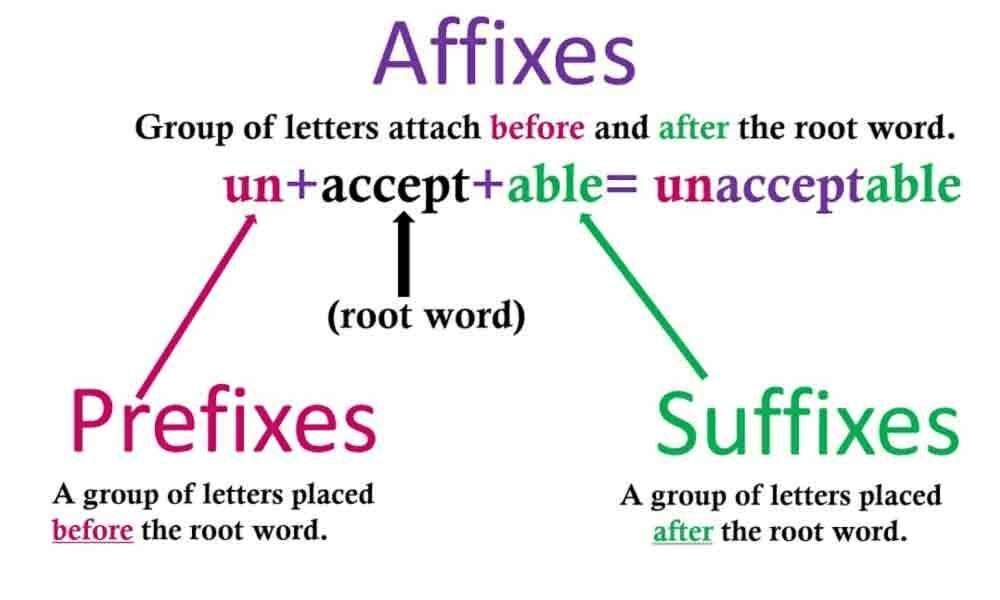
In linguistics, an affix is a morpheme that is attached to a word stem to form a new word or word form. Affixes may be derivational, like English -ness and pre-, or inflectional, like English plural -s and past tense -ed.
They are bound morphemes by definition; prefixes and suffixes may be separable affixes. Affixation is the linguistic process that speakers use to form different words by adding morphemes at the beginning (prefixation), the middle (infixation) or the end (suffixation) of words.
A prefix is an affix which is placed before the stem of a word. Adding it to the beginning of one word changes it into another word. For example, when the prefix un- is added to the word happy, it creates the word unhappy. Particularly in the study of languages, a prefix is also called a preformative, because it alters the form of the words to which it is affixed.
Prefixes, like other affixes, can be either inflectional, creating a new form of the word with the same basic meaning and same lexical category (but playing a different role in the sentence), or derivational, creating a new word with a new semantic meaning and sometimes also a different lexical category. Prefixes, like all other affixes, are usually bound morphemes.
In English, there are no inflectional prefixes; English uses suffixes instead for that purpose. The word prefix is itself made up of the stem fix (meaning “attach”, in this case), and the prefix pre- (meaning “before”), both of which are derived from Latin roots.
In linguistics, a suffix (sometimes termed postfix ) is an affix which is placed after the stem of a word. Common examples are case endings, which indicate the grammatical case of nouns, adjectives, and verb endings, which form the conjugation of verbs. An inflectional suffix is sometimes called a desinence or a grammatical suffix or ending. Inflection changes the grammatical properties of a word within its syntactic category. Derivational suffixes can be divided into two categories: class-changing derivation and class-maintaining derivation

 The Lectures